

Customer follow-up automation
Stay connected at every stage of the customer relationship.
A customer’s next step may come today or months from now. TECOBI brings configured follow-up, customer conversations and your dealership team together, so you can stay helpful across the buying journey and after the sale.
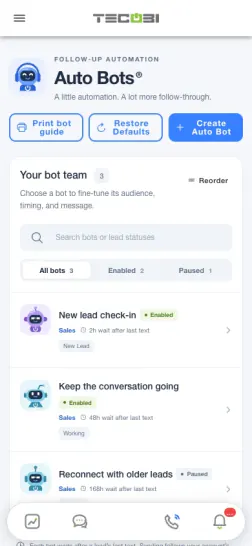
Map the quiet stretch after the first reply
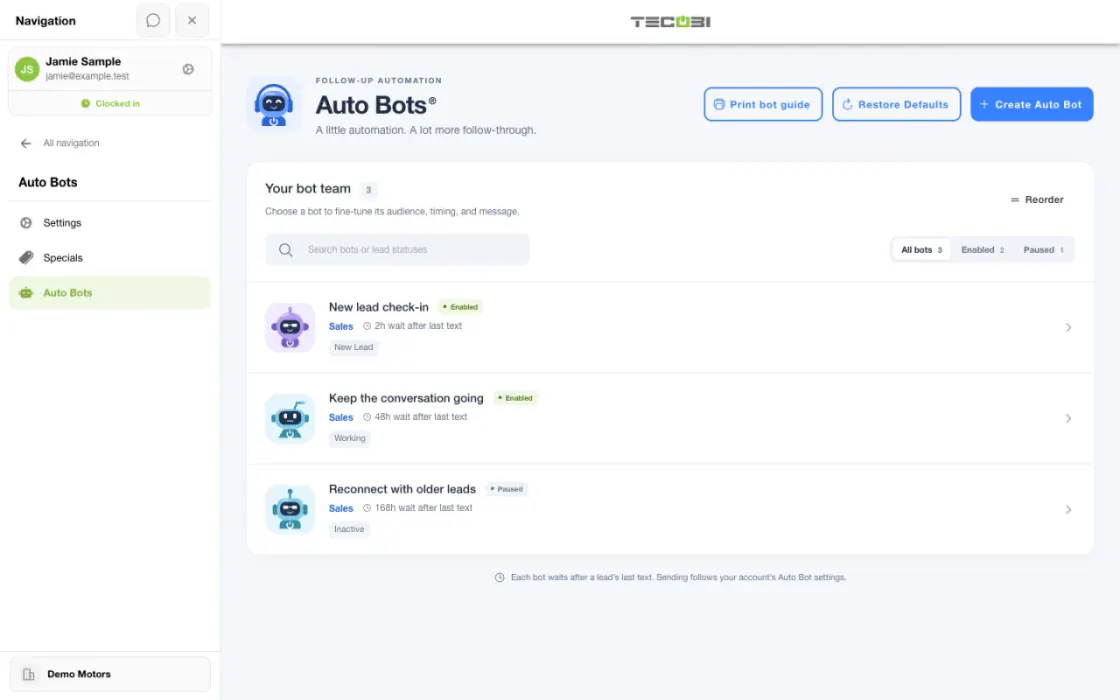
A shopper asks for information, then goes quiet. Use a follow-up that matches their current status and pick up when they return.
- Review the conversationCheck what the customer already received and do not repeat the same question.
- Configure the next touchReview the supported timing, guidance and eligibility for that situation.
- Return to the personUse the thread and the latest reply when a salesperson takes over.
Start with a relevant first response
Connect the first conversation with a longer customer journey.
- Dealership-written Auto Response templates can use a source-specific version or a default first message.
- Configured new-lead follow-up is a separate workflow with its own timing and eligibility rules. Email follow-up is configured separately from text follow-up.
- An incoming response belongs in the customer conversation, where eligible Response Bot handling or the dealership team can continue the discussion.
Welcome a customer back when interest returns
A returning inquiry can be a reason to begin another conversation.
- A returning lead submission can enter a separate configured re-engagement sequence. Its timing is connected to the renewed inquiry, with eligibility checks for replies, human activity, appointments, status and pauses.
- A website visit or inbound text alone is not the same trigger as a new lead submission.
- Configured vehicle-acquisition lead follow-up is a separate workflow for the eligible customer situation; its timing and rules depend on the dealership setup.
Help customers prepare for a visit
Use the appointment and the conversation together.
- Configured appointment reminders use the appointment time and the dealership’s selected timing. Availability, customer eligibility and processing affect whether a reminder is sent.
- Other configured appointment workflows can support follow-up after an appointment or particular recorded appointment outcomes. These workflows use their own conditions and are not interchangeable with the reminder.
- Keep the appointment status and customer conversation current so the team has useful context for the next step.
Give customers a useful reason to reconnect
Follow-up can share relevant new information rather than repeat the same question.
- A configured price-drop message can reach eligible leads who liked a vehicle when its recorded selling price decreases and the vehicle remains in stock.
- This uses connected inventory data and a separate message template. It does not mean every inventory change sends a message or that the system negotiates a price.
- TECOBI supports a configured check-in a chosen number of days after a recorded vehicle sale, using available details of the vehicle purchased.
- A configured birthday follow-up uses the customer birth date on record and the dealership’s selected local hour; missing data or eligibility restrictions can prevent a message.
Use AI and templates for the right jobs
Give the dealership a connected approach without confusing the different workflows.
- Event-triggered template automations are separate from AI Auto Bots. Each workflow has its own configuration, timing and eligibility checks; no universal cadence or identical inactivity rule applies to all of them.
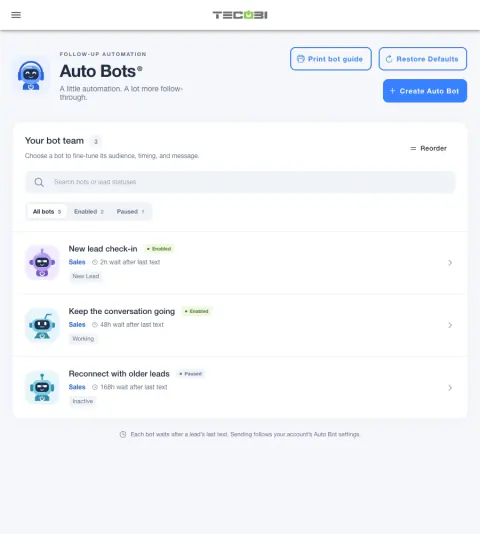
- Auto Bots use AI and prompt guidance for proactive follow-up. Response Bot handles eligible inbound text replies or brings a question to a person when judgment is needed.
- Pauses, customer communication restrictions, hours, status and processing can affect outreach. A prepared or sent message, customer response, appointment and sale are separate events.
Put the workflow into practice.
Identify the customer situation: a new or returning inquiry, an upcoming visit, a vehicle update or a completed sale.
Choose the relevant configured follow-up workflow and review its message, timing and available account settings.
Keep the resulting conversation with the customer record so the dealership can respond to replies and choose the next step.
Review the underlying conversations, activity and recorded outcomes to improve the process.
Connected TECOBI tools
Customer story · Carlson Chevrolet
Carlson Chevrolet customer story
Carlson Chevrolet uses TECOBI to keep long-term follow-up organized, protect messaging compliance, and turn older leads into active conversations when customers are ready to buy.
Questions dealers ask
Are all TECOBI follow-up messages written by AI?
No. Auto Bots use AI and prompt guidance for proactive follow-up. TECOBI also has separate configured template automations for particular events. Those can include returning lead submissions, vehicle acquisition inquiries, selected appointment outcomes, price drops, post-sale check-ins and birthdays. Use the appropriate workflow for the customer’s situation.
What happens when a previous lead submits another inquiry?
A returning lead submission can enter a separate configured re-engagement sequence. Its timing is connected to the renewed inquiry, with eligibility checks for replies, human activity, appointments, status and pauses. A website visit or inbound text alone is not the same trigger as a new lead submission.
Can follow-up give shoppers new information about a vehicle?
A configured price-drop message can reach eligible leads who liked a vehicle when its recorded selling price decreases and the vehicle remains in stock. This uses connected inventory data and a separate message template. It does not mean every inventory change sends a message or that the system negotiates a price.
Does follow-up continue after a customer buys?
TECOBI supports a configured check-in a chosen number of days after a recorded vehicle sale, using available details of the vehicle purchased. This is a separate template workflow for continuing the relationship after delivery. It is not automatic service scheduling or a promise that every customer will receive a message.
Are appointment reminders available?
TECOBI supports appointment reminder and follow-up workflows. The messages and timing depend on the configured workflow, customer contact information and communication eligibility. A reminder being configured does not guarantee delivery or attendance.
How are Response Bot and Auto Bots® different?
Auto Bots® handle proactive follow-up and reactivation. Response Bot handles inbound customer replies, decides whether AI should respond and routes the next action.
Can we see whether follow-up is helping?
TECOBI reporting shows bot activity, response patterns, prompt performance and appointment influence. Sold-outcome attribution adds another view of the customer journey; activity alone is not a sale.
Setup and availability
Auto Bots® Follow-Up: setup and availability
Auto Bots® handle proactive text follow-up. Inbound Response Bot replies, staff phone calls and this website’s Talk guide are separate workflows.
Your dealership’s audience, timing, hours and sending controls determine which conversations are eligible. Recent activity, customer restrictions and human handoffs can pause or change the next touch.
Authorized users can review and adjust the configuration. Follow-up and reporting help your team work opportunities; they do not guarantee a response or sale.
Event-triggered template automations are separate from AI Auto Bots. Each workflow has its own configuration, timing and eligibility checks; no universal cadence or identical inactivity rule applies to all of them.
AI Texting & Response Bot: setup and availability
Reply modes, delays, permissions and customer context determine when Response Bot runs. Connected inventory and appointment workflows depend on the dealership’s configuration.
Negotiation, finance decisions and questions requiring dealership judgment need a person. An AI answer is not a binding out-the-door quote or finance approval.
Dealership AI calling is not available yet. The website’s Talk guide explains TECOBI; it does not access private accounts or perform customer actions.
The example shows the shared conversation workspace with demonstration identities. It does not identify a particular message as AI-written.
Business Texting for Dealership Teams: setup and availability
Texting requires an eligible contact and correctly configured sending number; carrier delivery is not guaranteed.
Opt-out and account controls may restrict sending. Staff should respect customer contact preferences.
Available media types and delivery behavior differ between SMS, MMS, links and email.
Appointment Scheduling: setup and availability
Booking options depend on configured event types, availability, the calendar connection and the customer’s access.
Calendar-aware scheduling depends on the available calendar data and does not guarantee every conflict is detected.
Reminders and recorded appointment statuses do not guarantee message delivery, attendance or a sale.
The product image shows the customer’s booking entry point with no upcoming appointments, not a confirmed booking or a calendar availability screen.
Store booking, event assignment and capacity enforcement require their own configuration and eligible calendar connections. Check-in and board status are recorded workflow information, not independent proof of physical arrival or a sale.
Automotive CRM & Lead Management: setup and availability
Available tools depend on dealership configuration and user permissions.
Integration coverage varies by provider; TECOBI does not automatically synchronize every field with every CRM or DMS.
Pipeline and activity screens describe recorded work; they do not guarantee a sale or prove why it happened.
Survey access depends on dealership membership and user role or assignment. Automatic post-sale survey requests require enabled configuration and an active sending workflow; no universal schedule, delivery or response is promised.
Text Ninjas is an optional service. Confirm the service scope, coverage hours, handoffs and current pricing with TECOBI. No particular staffing ratio, response-time guarantee or managed phone service is promised here.
Sales & AI Reporting: setup and availability
Available report views and drill-down access depend on account permissions and configuration.
Reports describe recorded data and defined attribution rules; they do not guarantee results or establish causation.
Example screenshot values illustrate the interface and are not promised dealership performance.
Submission and assignment history depend on when tracking began. A period can have partial or unavailable coverage.
Vehicle Demand uses recorded interest and current in-stock inventory. It does not measure every shopper, predict future sales or automatically purchase inventory.
ASK ME ABOUT IT