01 Speed depends on availability
The first response still depends on which salesperson is free, watching the right screen, and ready to stop what they are doing.
AI powered CRM operational layer
For decades, old CRMs have depended on salespeople to log notes, chase task lists, remember follow-up, and manually keep every opportunity alive. TECOBI uses AI to handle the repetitive CRM work so your team can spend more time selling, building trust, and stepping in when a real human decision matters.
The CRM problem
Legacy CRMs were built for storing customers, logging activity, and reminding people what to do next. That made sense when the job was mostly record keeping. It breaks down when buyers expect instant answers, persistent follow-up, text-first communication, and clean handoffs at every hour of the day.
01 The first response still depends on which salesperson is free, watching the right screen, and ready to stop what they are doing.
02 Every lead creates more reminders, notes, status changes, and manual outreach. The CRM records the debt, but people still have to pay it down.
03 Modern buyers shop at night, during work breaks, and between errands. Legacy CRM workflows are still built around business-hour staffing.
04 Completed tasks can look productive while real buying signals, aging opportunities, and stalled conversations stay buried in the database.
05 Notes, calls, texts, source data, and status changes may all exist, but the customer story is still hard to understand quickly.
06 A buyer who is not ready today often becomes a dead record, even when they are still a future opportunity worth nurturing.
Salespeople are expected to be data-entry operators, reminder managers, appointment chasers, compliance monitors, and customer advisors at the same time.
The system of record became the system of manual work, which means revenue depends on perfect human task completion across thousands of conversations.
AI changes the operating model: routine conversation coverage, nurture, routing, and signal detection can run continuously while the team focuses on judgment and selling.
The shift
TECOBI is designed around that shift. AI handles the repetitive operational load so salespeople are not reduced to button-pushing robots, and managers get a clearer view of which conversations need human attention.
Hybrid intelligence
TECOBI is built around an operating model where AI manages routine conversation coverage, long-term follow-up, and signal detection. When a customer is ready, complex, frustrated, or financially specific, the work moves to the team.
What TECOBI orchestrates
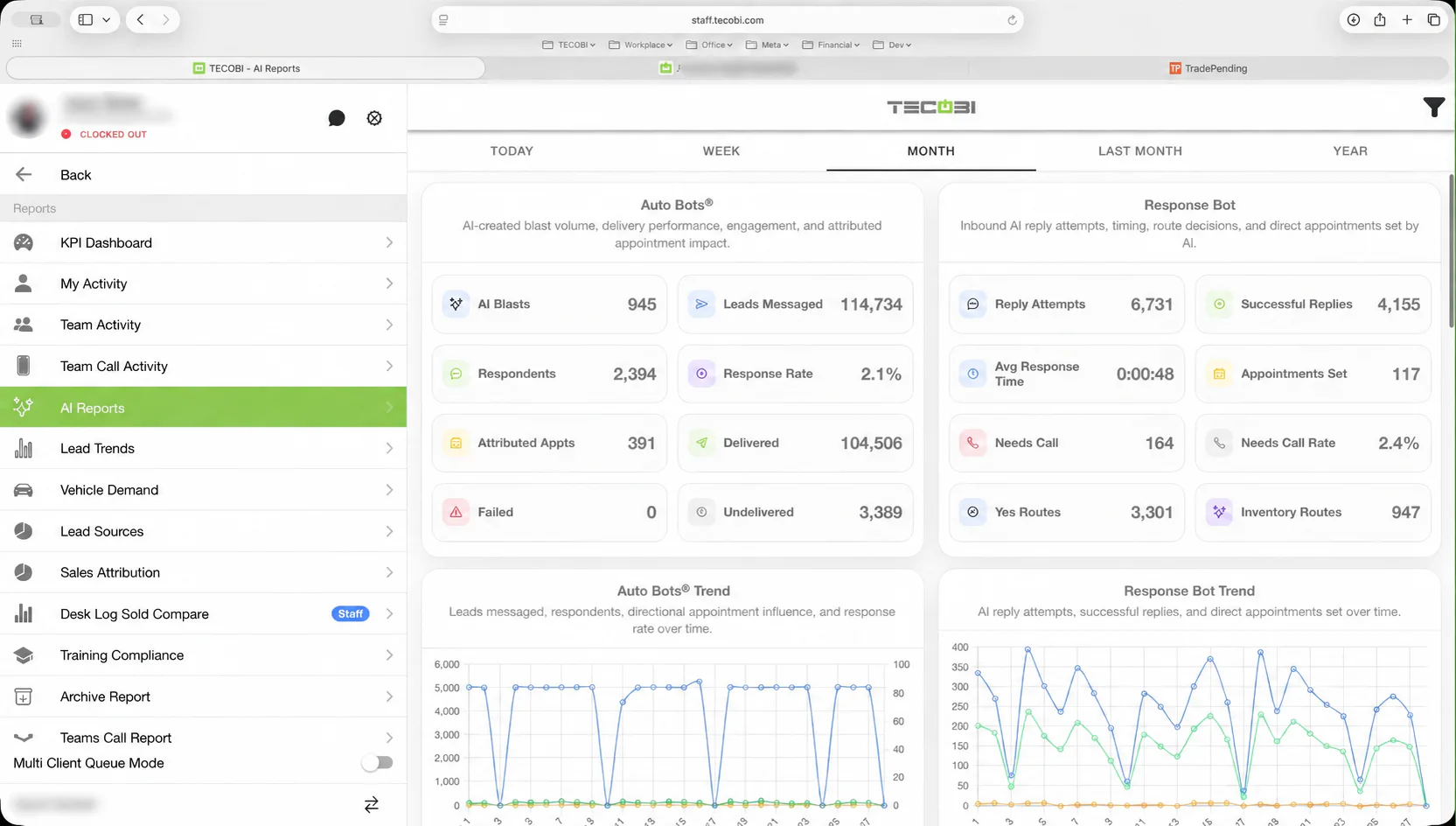
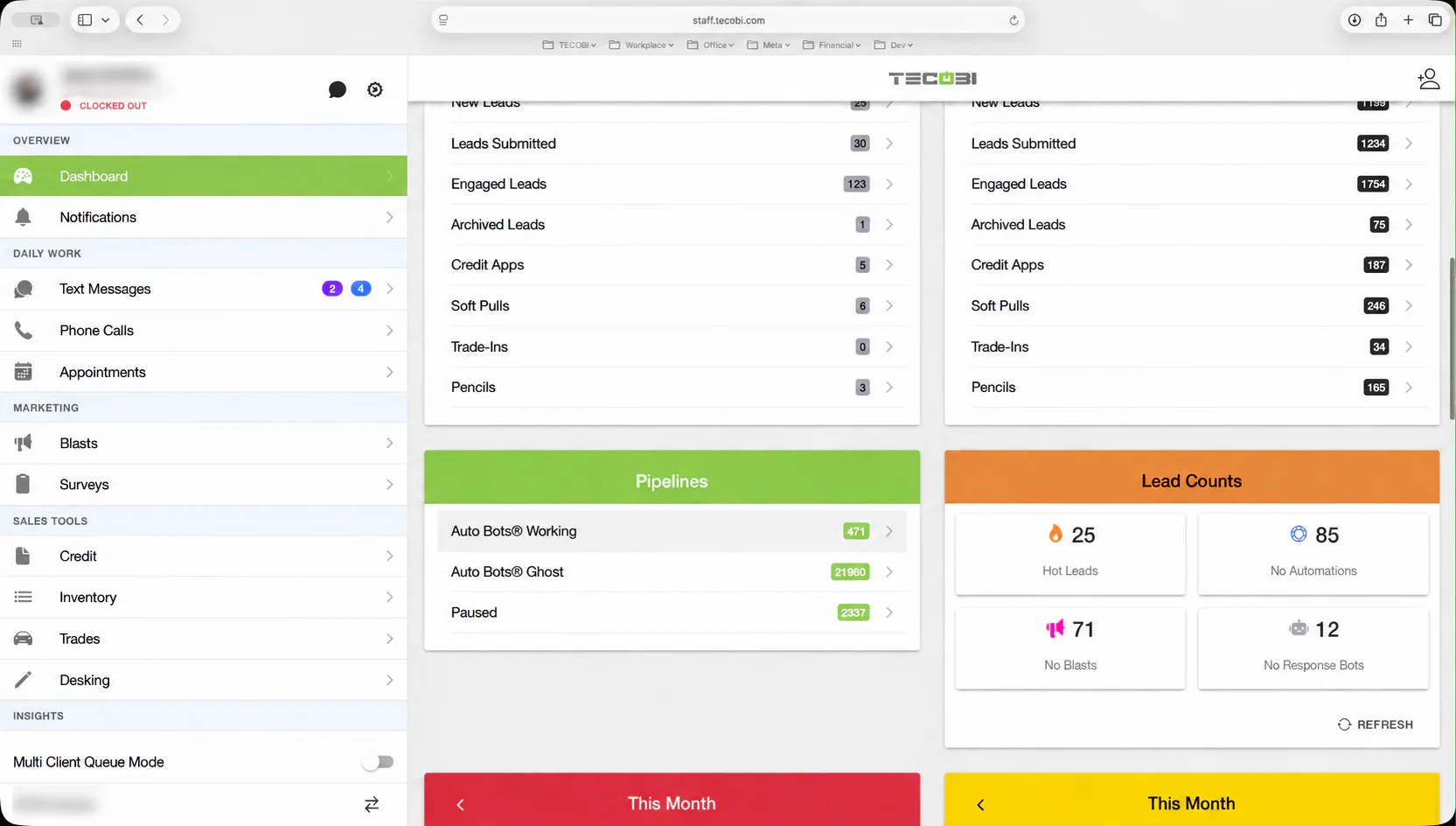
TECOBI helps your team keep conversations moving, protect customer communication, and see where demand is forming before opportunities slip away.
Connect first response, nurture, reactivation, appointment intent, and retention into one durable customer journey.
Protect the workflow with controls for timing, opt-out language, risk signals, and safer customer communication.
Surface the signals managers need: which sources create engaged demand, which conversations need humans, and where pipeline is forming.
Proof pattern
Demo research across real sales operations shows a consistent pattern: teams lose revenue when follow-up relies on memory, task completion, or business hours. TECOBI’s AI operating model turns those gaps into managed pipeline.
Google reviews
These synced Google reviews show how customers describe the response, follow-up, and handoff experience after TECOBI is working in the store.
Highest-rated automotive vendor on Google
Pulling the latest Google review signal from TECOBI’s Google Business Profile.
Insights
Explore how AI follow-up, text-first communication, compliance controls, and lifecycle automation help teams respond faster and manage more demand.
Automotive AI
AI should not be framed as a replacement for dealership sales teams. The practical opportunity is to divide customer communication into the right lanes: automate instant acknowledgment, routine follow-up, appointment reminders, and aged lead reactivation; use AI to classify replies and summarize context; and hand off deal-making, empathy, finance concerns, trade complexity, and unusual situations to people.
Read more about Human-Plus-AI Dealership Communication: What AI Should Handle and What Still Needs a Person
Automotive AI
AI agents are showing up inside every CRM, but dealerships should evaluate them by operational impact, not chatbot demos. A useful AI CRM operating layer stays connected to the customer record, handles inbound replies, runs persistent follow-up, supports appointment scheduling and no-show recovery, revives aged leads, and hands conversations to humans with context. The goal is fewer dropped conversations and less manual cleanup for managers.
Read more about AI Agents for Dealership CRM: Don’t Buy a Chatbot When You Need an Operating Layer
Powersports CRM
Powersports and RV dealerships cannot rely on task queues alone when shoppers are active on weekends, buying cycles stretch for weeks or months, and staff are busy with showroom traffic. This post explains how TECOBI’s AI CRM operating layer helps cover inbound replies, run proactive follow-up, surface engaged shoppers, support appointments, and hand conversations to humans when buyers are ready.
Read more about AI CRM for Powersports and RV Dealers: Keep Seasonal Buyers MovingResources
guide
Client-facing reference for the Google Analytics events TECOBI's website widget sends into the analytics installation already running on your website.
Read more about Website Widget Google Analytics Signalsguide
Client-ready instructions for website providers installing TECOBI widget forms, embedded forms, SRP and VDP CTAs, and finance-related lead capture flows.
Read more about Website Integration InstructionsStart with the operating model
Book a walkthrough of TECOBI’s AI CRM operating layer and how it can fit your current lead, customer, and follow-up workflow.