
Search volume around “Automotive AI CRM” is growing because dealers are tired of the same old CRM problem: the lead arrives, the task gets created, the salesperson gets busy, and the customer conversation goes cold. The promise of AI is not another shiny dashboard. The useful version is an operating layer that responds, follows up, routes, reminds, reports, and hands off to people at the right time.
For dealership operators, the question is simple: does the system help your team sell more cars with less dropped communication, or does it just create a new place to click around? This guide explains what an Automotive AI CRM should actually do, where it fits beside your existing CRM, and how TECOBI approaches AI-assisted customer conversations for sales teams, BDCs, internet departments, and managers.
What Is an Automotive AI CRM?
An Automotive AI CRM is a customer communication and follow-up layer built for the dealership sales process. It should understand lead sources, customer intent, appointment flow, opt-outs, salesperson ownership, manager visibility, and the reality that shoppers answer at unpredictable times. Traditional CRMs are usually built around records, tasks, notes, and pipeline stages. Those things still matter.

But they do not automatically keep the conversation alive. An Automotive AI CRM should sit closer to the customer conversation: inbound replies, outbound nurture, appointment reminders, reactivation, and handoff moments. That is why TECOBI positions AI CRM as an operating layer, not a replacement for every system in the store. The goal is to keep communication moving while your existing CRM remains the system of record where needed.
- Respond to inbound customer replies quickly, including after hours.
- Run persistent follow-up without relying on every salesperson to clear every task manually.
- Hand active buyers to humans when intent, urgency, or complexity requires it.
- Give managers visibility into conversations, engagement, source performance, and outcomes.
- Support appointment setting, reminders, reactivation, and targeted broadcasts in one workflow.
The Real Test: Can It Handle Inbound Replies Without Losing the Customer?
The first test of any Automotive AI CRM is what happens when a customer replies. A shopper may text back during lunch, after the store closes, while the salesperson is with another customer, or three weeks after the original lead. If that reply sits unnoticed, the dealership loses momentum. A useful AI CRM should not treat inbound responses as generic chatbot traffic.
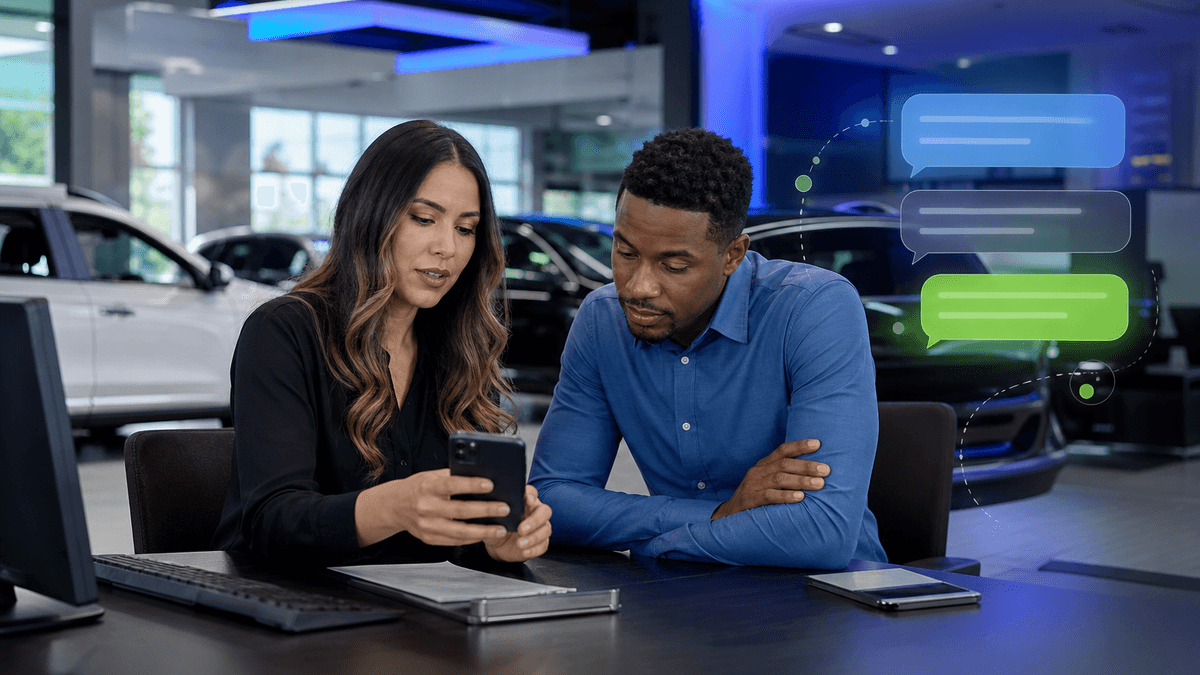
It should recognize that the dealership needs speed, context, and control. TECOBI’s Response Bot is built around inbound handling and human handoffs, so customer replies can be engaged quickly while the right team member is brought in when the conversation needs a person. This matters because dealership communication is rarely linear. A customer may ask about availability, credit, trade value, appointment times, down payment, or whether a vehicle is still on the lot.
AI can help keep the thread alive, but the store still needs clear ownership when the conversation becomes a real deal.
- Inbound replies should be monitored continuously, not only when a rep checks the CRM.
- AI should identify when a conversation needs a human handoff.
- Managers should be able to see whether replies are being worked, not just whether tasks exist.
- The customer should experience one continuous conversation instead of disconnected follow-up attempts.
Proactive Follow-Up Is Where AI CRM Earns Its Keep
Most dealerships do not have a lead problem as much as they have a follow-up consistency problem. Fresh leads get attention. Hot conversations get worked. But the undecided shoppers, credit maybes, no-shows, aging internet leads, and “not right now” customers often fall into task queues that nobody trusts.
This is where Automotive AI CRM earns its keep. TECOBI’s Auto Bots are designed for proactive follow-up, nurture, and reactivation. The point is not to blast the same message forever. The point is to keep appropriate, persistent communication moving so that interested shoppers are not abandoned just because they did not buy on day one.
For managers, this changes the operating model. Instead of asking, “Did everyone complete their tasks?” the better question becomes, “Which customers are engaged, which need a human, and which campaigns are creating real opportunities?”
- Follow-up should continue beyond the first few days of lead arrival.
- AI should help revive older leads without forcing staff to manually restart every conversation.
- Salespeople should spend more time with engaged buyers and less time clearing low-value reminders.
- Managers should be able to inspect active conversations and intervene when needed.
Appointments, Handoffs, and the Point of Human Control
AI CRM should not be judged by how many messages it sends. It should be judged by whether it moves customers to useful next steps. In a dealership, that usually means a confirmed appointment, a phone call, a credit application, a trade discussion, a manager review, or a salesperson handoff. This is why appointment scheduling and handoff logic matter.
A shopper who is ready to come in should not be trapped in an automation loop. A customer asking a complex finance question should not receive canned responses. A sales manager should know when the AI has created a real opportunity that needs human attention. TECOBI supports customer self-scheduling, reminders, appointment reporting, inbound handling, and human handoffs so the AI layer can support the actual sales process instead of operating separately from it.
- AI should know when to stop nurturing and start routing.
- Appointment workflows should be visible to managers and salespeople.
- Reminder logic should reduce no-shows without making the customer feel spammed.
- Human handoff should preserve conversation context so the customer does not have to start over.
Reporting Should Show Outcomes, Not Just Activity
A manager does not need another report showing that 700 tasks were created. The useful question is whether customer communication is producing engagement and outcomes. Automotive AI CRM reporting should help managers inspect the full path: source quality, inbound replies, outbound follow-up, calls, appointments, handoffs, opt-outs, and sales outcomes where available. That is especially important because many AI touchpoints assist the deal before the final conversion happens.
If the store only credits the last click or the last person who touched the customer, the reporting will understate the value of persistent follow-up. TECOBI’s reporting is built around AI performance, engagement, calls, sources, and outcomes so dealership leaders can manage the process instead of guessing from activity counts.
- Look for source-level reporting that shows which lead channels are creating engaged conversations.
- Track AI-assisted replies and handoffs, not only final sold records.
- Review appointment activity and show opportunities alongside messaging engagement.
- Use reporting to coach process breakdowns, not just audit individual employees.
Compliance and Message Control Cannot Be an Afterthought
Dealership messaging is not a place to improvise. AI CRM must operate with guardrails around opt-outs, message control, consent-aware workflows, and customer experience. The store should be able to scale communication without losing control of who is being contacted, when, and why. That does not mean AI should make legal promises.
It means the system should help enforce practical safeguards, keep opt-out handling visible, and give managers better control than a patchwork of personal phones, disconnected texting tools, and inconsistent salesperson habits. TECOBI Shield and consent-aware messaging safeguards are built for this operating reality. For dealerships, the standard should be simple: automation should make communication more controlled, not more chaotic.
- Opt-out handling should be clear and operationally visible.
- Message governance should apply across AI, broadcasts, and human follow-up.
- Managers should know which communication workflows are running.
- AI should support dealership control instead of creating unsupervised customer contact.
How to Choose the Right Automotive AI CRM for Your Store
Automotive AI CRM should work with your dealership’s operating structure, not against it. A single-point independent store, a franchise rooftop, a multi-location group, and a powersports dealership may all need different handoff rules, reporting views, and follow-up strategies. The best way to evaluate a system is to map the customer journey from first lead to sold unit and then ask where communication breaks today. Do inbound replies get missed after hours?
Do older leads stop receiving meaningful follow-up? Do managers know which sources create conversations? Are appointment reminders consistent? Are opt-outs handled cleanly?
Are salespeople overloaded with tasks that do not reflect real buying intent? TECOBI customer stories show several operating models: high-volume lead handling, leaner BDC structures, no-BDC stores, long buying cycles, and multi-location follow-up alignment. The common thread is not “AI for AI’s sake.” It is consistent customer communication with manager visibility and human control.
- Define who owns each handoff before turning on automation.
- Decide which lead types need immediate response, long-term nurture, or manager review.
- Use AI to remove repetitive follow-up pressure while keeping salespeople accountable for live opportunities.
- Review reporting weekly so automation becomes part of the sales process, not a side project.