
Most dealership reporting still tries to answer a modern question with an old lens. It shows where the lead came from, maybe who touched it first, maybe who closed it. That is useful, but it is not enough when AI is handling response, follow-up, reactivation, and handoff inside the conversion path. If your dealership only measures first-touch or last-touch, you are missing the work that actually keeps customers engaged.
AI is not just another lead source. It is part of the journey. That means it should be measured as influence, not just origin.
Why first-touch and last-touch miss the real journey
Dealership managers know the problem: a lead may come from one source, get opened by AI, re-engaged days later, handed to a rep, then converted after several more touches. A single attribution label cannot tell that story. First-touch gives credit to the first capture point. Last-touch gives credit to the final step before the sale.

Both can be true and still incomplete. In between those two points are the moments that often decide whether the opportunity stays alive. That is especially important when AI is doing real work in the middle of the funnel. If a Response Bot handles the inbound reply, an Auto Bot keeps the conversation active, and a human finishes the handoff, the dealership should not treat those as invisible support functions.
They are part of the path to conversion.
- First-touch often overvalues the original lead source and undervalues follow-up.
- Last-touch can make the final human step look like the only driver.
- AI-led response and nurture happen between capture and close, where most deals are won or lost.
- A useful report should show how the conversation moved, not just where it started.
- Managers need attribution that reflects both automation and human intervention.
Why activity metrics alone are not enough
A lot of dealership dashboards are busy without being useful. They count messages sent, replies received, calls made, tasks completed, and maybe appointment outcomes. That is activity reporting. It is not the same as attribution.
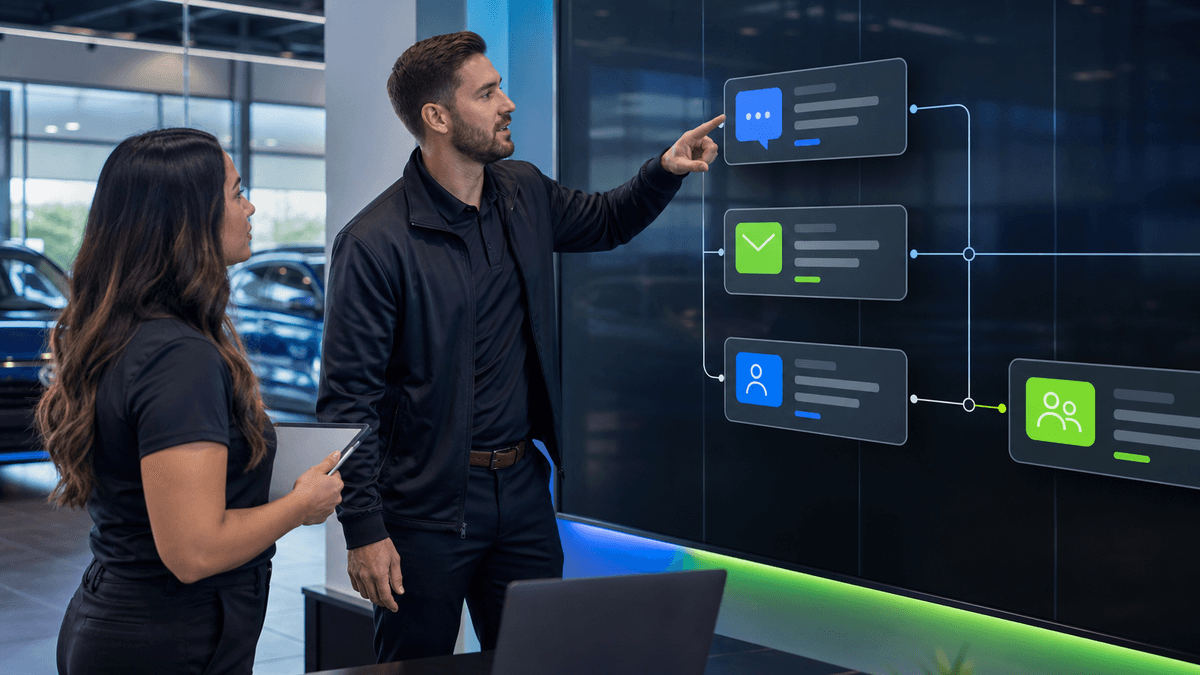
Activity tells you that work happened. Attribution tells you what that work influenced. That distinction matters because a high volume of activity can still produce weak results if it is not attached to the customer journey. A manager needs to know whether AI helped restart a stalled conversation, moved a shopper back into active engagement, or supported a handoff that led to an appointment or sale.
Without that context, teams can end up rewarding motion instead of progress. The result is a report that looks productive while still leaving conversion gaps unexplained.
- Activity metrics answer: what did the team do?
- Attribution metrics answer: what did the customer do after that?
- A message count without outcome context can reward busy work.
- Reply rate alone does not show whether engagement advanced.
- Appointment and sale outcomes should be tied back to the touches that influenced them.
What a useful attribution model should tell a manager
A useful attribution model for a dealership should not try to be clever for its own sake. It should help a manager answer simple operational questions. Did AI start the conversation fast enough? Did it keep the lead warm when a rep was unavailable?
Did it reactivate older leads that had gone cold? Did the handoff happen at the right time, with enough context for the salesperson to continue the deal? If the report can show those answers, a manager can coach differently. They can see whether a response problem is really a speed problem, whether a nurture problem is really a sequence problem, and whether a handoff problem is really a visibility problem.
That is the point of AI attribution in a dealership. It should show where the system helped, where humans took over, and where opportunities dropped out along the way.
- Response timing: how quickly the lead was engaged.
- Nurture influence: whether follow-up kept the conversation active.
- Reactivation value: whether older leads were brought back into motion.
- Handoff quality: whether a human received the lead with enough context.
- Outcome linkage: whether the sequence led to appointment, show, or sale.
AI should be measured as part of the conversion path
Dealerships also need to stop treating AI as if it were just another source bucket. It is not the same as a third-party lead form, a paid social campaign, or an organic walk-in. AI can touch the same lead multiple times across the lifecycle. It can answer immediately, continue the conversation when nobody is available, revive dormant opportunities, and prepare the handoff for a rep.
That makes AI part of the conversion path itself. When reporting reflects that reality, leaders can make better staffing decisions, better process decisions, and better coaching decisions. They stop asking, “Which source produced the lead?” and start asking, “Which system kept the lead alive long enough to convert?” That is a much better management question.
- AI influence can span multiple stages, not one source event.
- The same lead may be helped by automation and a human in sequence.
- Reporting should connect AI touchpoints to downstream opportunities.
- Managers can coach speed, persistence, and handoff quality when the data is visible.
- The question is not whether AI is a source; it is whether AI moved the deal forward.
How TECOBI reporting clarifies engagement influence
TECOBI’s reporting is built for dealerships that want to understand engagement influence more clearly. That means seeing how inbound handling, proactive follow-up, reactivation, appointment activity, and human handoffs work together instead of standing in separate reports. For managers, that creates a more honest view of performance. You can see which conversations stayed alive, which flows created movement, and where the team needs coaching or process changes.
You are not left guessing whether AI was just busy or actually useful. In other words, TECOBI helps teams measure the path, not just the point of entry or the final click. That is the level of visibility a dealership needs if AI is part of the operating model.
- See engagement influence across response, nurture, reactivation, and handoff.
- Coach the process with context instead of isolated activity counts.
- Use reporting to compare where conversations start with where they actually progress.
- Spot where automation supports the team and where human follow-through matters most.
- Measure the operating system behind the sale, not just the source label.