
An inbound text reply is a live control problem. The customer has broken silence, changed the state of the deal, and given the dealership a small window to protect momentum. If the store treats that reply as just another notification, the next move becomes random: maybe a salesperson sees it, maybe a BDC rep claims it, maybe the customer gets a generic answer, or maybe the thread sinks behind newer tasks. That is why Response Bot should not be judged only by how quickly it sends a message.
Speed matters, but speed without classification can create noise. The correct sequence after a dealership receives an inbound text reply is: identify the reply type, preserve the full context, decide whether AI should continue or pause, route by ownership and urgency, then hand off to a human with the next move clear. This workflow teardown is for sales managers and CRM administrators who are evaluating how inbound handling should actually work after hours or during a busy showroom period. The goal is not more automation for its own sake.
The first five seconds are a control point, not a race
The moment a customer replies, the dealership needs to know what changed. A reply that says the customer wants to come in tomorrow is not the same as a reply asking whether a vehicle is still available. A credit concern is not the same as a trade-in update. A frustrated opt-out signal is not the same as a buying question.

The first operational mistake is treating every inbound reply as equal. That pushes the store into a speed contest before anyone knows what kind of conversation is in front of them. A useful Response Bot workflow starts by classifying the reply so the next action fits the message. For sales managers, this matters because inbound replies usually arrive when people are least available: after close, during a rush, while the salesperson is on a test drive, or while the BDC is catching up.
The bot has to stabilize the thread before the store can act.
- Buying intent: appointment interest, vehicle availability, pricing, trade, financing, or readiness to speak with someone.
- Service or administrative intent: title, documents, payment, status update, or non-sales request that should not be forced through the sales lane.
- Risk and preference signals: stop requests, wrong number, frustration, language preference, or anything that should change how the store communicates.
- Ambiguous replies: short answers like “yes,” “maybe,” “how much,” or “call me” that require context from the prior conversation before action is taken.
Step 2: Preserve the customer’s trail before anyone touches the thread
Classification without context is brittle. If a customer replies “I can do 5,” the system should know whether the prior message asked about an appointment time, a down payment, a monthly payment target, or a call window. If a shopper writes “still got it?” the answer depends on the vehicle, the source, and the conversation history. This is where many dealership workflows break.
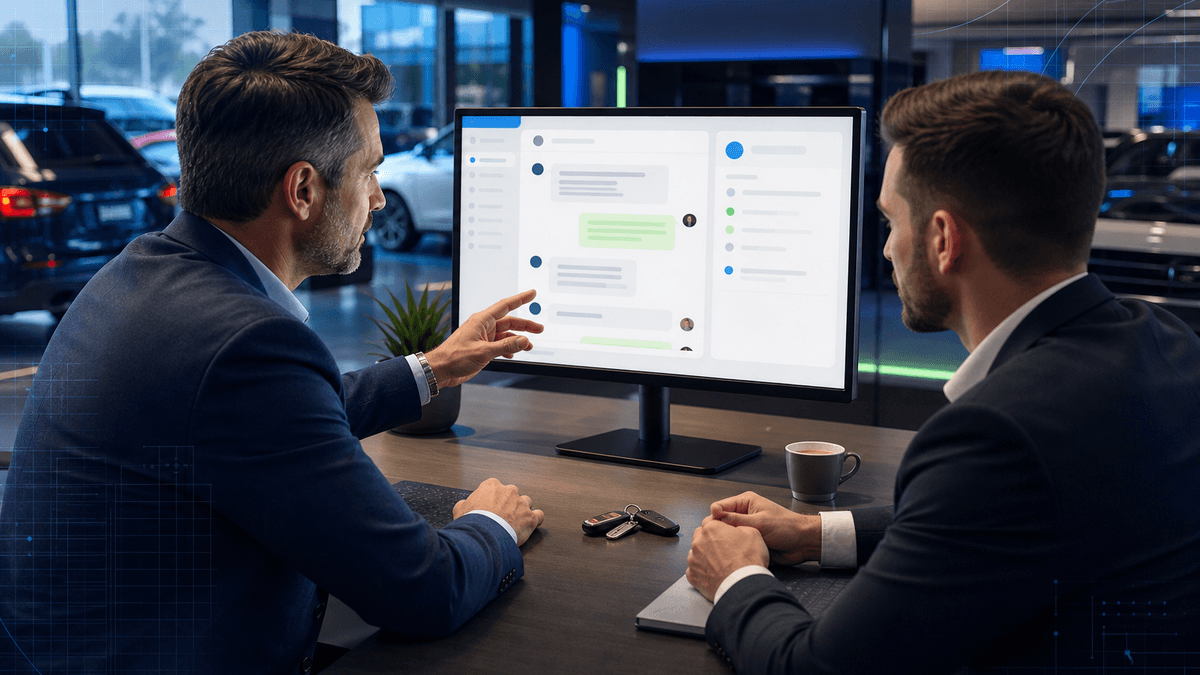
The customer’s reply gets separated from the thread that explains it. A salesperson sees the latest bubble but not the last question. A manager sees an open task but not the customer’s intent. Another rep jumps in and asks something the customer already answered.
A Response Bot operating layer should preserve the customer’s trail before anyone touches the thread. That means the bot is not just generating a reply. It is carrying forward the prior conversation, lead source, ownership, appointment status, opt-in state, and any known buying signals so the next action does not reset the relationship.
- Keep the latest reply connected to the prior prompt that triggered it.
- Carry forward appointment, vehicle, trade, finance, and source context where available.
- Avoid forcing the customer to repeat information the store already has.
- Make the handoff readable enough that a salesperson can understand the situation without reconstructing the whole thread.
Step 3: Decide whether AI should answer, clarify, pause, or escalate
The bot should not always continue the conversation. Sometimes the right answer is a helpful automated response. Sometimes the right answer is to stop, flag, and route. The difference is intent.
A simple inventory or scheduling question may be safe for AI to continue, especially after hours. A hot buying signal may need a human immediately. A complaint, opt-out, or sensitive finance discussion may need a tighter handoff. A vague reply may need a clarifying question before the store assigns a person.
This is the practical difference between an inbound handler and a generic chatbot. Response Bot is valuable when it can decide whether continuing the AI conversation helps the deal or risks muddying ownership. The point is not to keep AI talking as long as possible. The point is to keep the customer moving toward the correct next step.
- Continue when the reply is routine, answerable, and does not require a specific staff member.
- Clarify when the reply is too short or ambiguous to route confidently.
- Escalate when the reply shows high intent, frustration, a compliance-sensitive preference, or a request for direct human help.
- Pause automation when a human has taken ownership so the customer does not receive crossed signals.
Step 4: Route by ownership and urgency, not by convenience
Routing is where the workflow either becomes accountable or collapses into a queue. The easy route is to dump the reply into a shared inbox and hope the right person claims it. The better route is to use ownership and urgency to decide where the thread belongs. If a salesperson owns the customer and is available, the thread should surface to that person with context.
If the owner is off, busy, or outside coverage, the workflow needs a fallback path. If the customer is asking to come in today, urgency should override passive assignment. If the message is a non-sales request, it should not distract the sales lane. This is especially important during a busy showroom period.
Managers often assume missed replies are an after-hours problem, but Saturday traffic creates the same failure mode. Salespeople are physically present but mentally unavailable. Without controlled routing, the store looks staffed while digital customers wait.
- Route to the current owner when that person is the correct next contact.
- Escalate to a manager or coverage role when the owner is unavailable and the reply is urgent.
- Separate sales, service, administrative, and compliance-sensitive replies so the wrong team does not slow the customer down.
- Make fallback rules visible so managers know whether a reply is waiting, owned, or resolved.
Step 5: Hand off with the next move already framed
A handoff is not clean just because a human was notified. The human needs the shortest possible path to a competent next response. The handoff should answer four questions: Who is the customer? Why did they reply now?
What has already been said? What should happen next? If a salesperson has to reread the entire thread, search the CRM, check appointment notes, and guess whether the bot already responded, the workflow has not really saved time. This is the point where AI should make the salesperson better, not invisible.
A good handoff lets the rep enter the conversation with confidence: confirm the appointment, answer the vehicle question, call the customer, update the trade note, or ask the manager for a desked option. It should reduce hesitation, not create another thing to interpret.
- Summarize the customer’s latest intent without inventing facts.
- Show whether AI already answered, clarified, or paused.
- Preserve the recommended next move so the salesperson knows how to pick up the thread.
- Keep manager visibility on whether the human pickup actually happened.
What managers should inspect the next morning
The next morning, managers should not only ask whether the bot responded. They should inspect whether the workflow kept control of the conversation. A fast answer that ended in no ownership is a vanity win. A slower answer that correctly classified urgency, preserved context, routed the thread, and produced a clean human pickup may be a better operating outcome.
CRM administrators should build review habits around conversation health, not just activity counts. This is also where Search Console demand matters for TECOBI content strategy. The query “Response Bot” has shown 317 impressions with an average position around 12 for the Response Bot page. That suggests dealers are already investigating the category.
The missing education is not whether a response bot exists; it is how the inbound sequence should work when the dealership cannot afford to lose the thread.
- How many inbound replies were classified into useful intent groups?
- How many urgent replies reached a human with context intact?
- Where did ownership fail: no assignee, unavailable owner, wrong department, or unclear next step?
- Which replies were resolved by AI, which were clarified, and which required human takeover?
- Which conversations still sat unresolved when the store opened or the rush ended?
The sequence that keeps the reply from disappearing
The correct sequence after an inbound text reply is not complicated, but it has to happen in order. First, classify the message. Second, preserve the context that gives the reply meaning. Third, decide whether AI should answer, clarify, pause, or escalate.
Fourth, route based on ownership and urgency. Fifth, hand off with the next human move already framed. Finally, inspect whether the conversation was actually resolved. That sequence is what separates Response Bot from a fast texting tool.
The dealership does not need more message volume. It needs control when customers raise their hand.
- Speed is useful only after the store understands the reply.
- Context prevents the customer from having to restart the conversation.
- Routing protects accountability during after-hours windows and showroom rushes.
- Human handoff should be a prepared pickup, not a cold interruption.