
Search Console shows demand for the query “automotive call tracking” with 185 impressions and an average position of 24.1 against TECOBI’s CRM category page. That is a useful signal: dealers are not only asking whether calls can be tracked. They are asking whether the phone activity they already measure is enough to manage sales conversations. For a sales manager, the answer is usually no.
Call tracking can tell you that a lead called, which source drove the call, whether the call was answered, how long it lasted, and sometimes what was said. That matters. But a call is only one event inside a larger buying conversation. If the reporting cannot show what happened before the call, what changed during it, and what follow-up happened after it, the store is still managing from fragments.
The practical thesis: automotive call tracking is incomplete if it captures the call but not the conversation state.
The teardown: where a call record stops helping
A call record is useful evidence, but it is not the same as workflow ownership. Most automotive call tracking answers event questions: Where did the call come from? Did someone answer? How long did it last?

Was it recorded? Did it convert? Those are important for marketing accountability and coaching. They are not enough for daily sales management.
The manager’s real problem is state. Before the phone rang, was this shopper already in a text conversation? Had they gone quiet for 12 days? Were they asking about credit, trade value, appointment availability, or a specific vehicle?
After the call, did someone confirm the appointment, send the next step, restart nurture, or let the customer drift? That is where call-only reporting breaks down. It reports a contact event without always explaining the customer’s current condition.
- Call tracking sees the phone event; managers need the customer state around the event.
- A long call may be productive, confused, duplicative, or unresolved unless it is tied to the thread.
- An answered call is not a completed workflow unless the next owner and next action are clear.
- A missed call is not just a missed call; it is a recovery workflow that should start immediately.
Step 1: Before the call, the customer already has momentum
Before a customer calls, there is usually a trail. A lead source. A form submission. A text exchange.
A prior missed connection. A price question. A trade concern. A service visit.
A finance objection. A no-show recovery attempt. If the call tracking system treats the phone call as the start of the story, the salesperson may ask questions the shopper already answered. That creates friction for the customer and weakens the manager’s read on performance.
The store may think it has a phone problem when the real issue is upstream context loss. A practical call workflow should begin with the customer’s latest known state, not the call timestamp. Sales managers should be able to answer: what was the dealership trying to accomplish with this customer before the phone rang? Were we confirming an appointment, reviving an aged lead, responding to a fresh inquiry, or recovering an inbound reply?
- Lead source explains origin, but conversation state explains what the customer needs now.
- Prior messages can reveal whether the call is a first contact, a continuation, or an escalation.
- Call coaching is sharper when managers can see whether the rep used the context already available.
- A call from an aged lead should not be handled the same way as a call from a same-day high-intent shopper.
Step 2: During the call, outcome beats duration
During the call, tracking can capture the audio, duration, source, and sometimes a scored outcome. That is helpful, but managers should be careful not to confuse recording with resolution. A five-minute call could mean the customer booked a firm appointment. It could also mean they asked for a callback from finance, wanted a trade estimate, objected to payment, or got transferred twice and left uncertain.
If the call outcome does not update the customer’s state, the next person touching that lead is guessing. The best use of call tracking is not to create another report for managers to audit after the fact. It is to feed the operating workflow while the deal is still alive. If the call changes intent, urgency, appointment status, vehicle interest, or owner, the system should preserve that change where follow-up happens.
- Duration is not quality by itself.
- Recording is not resolution by itself.
- A call disposition is weak if it does not change the next action.
- The most important output of a call is often the updated customer state.
Step 3: After the call, the workflow has to choose the next owner
The after-call step is where many stores lose the benefit of call tracking. A manager may see that a call was answered, but that does not prove the customer received the promised quote, appointment link, credit instruction, trade follow-up, or manager callback. If the next step depends on a salesperson remembering to create a task or type a note, the call tracking report becomes a history file instead of an operating tool. After a call, the workflow should decide ownership.
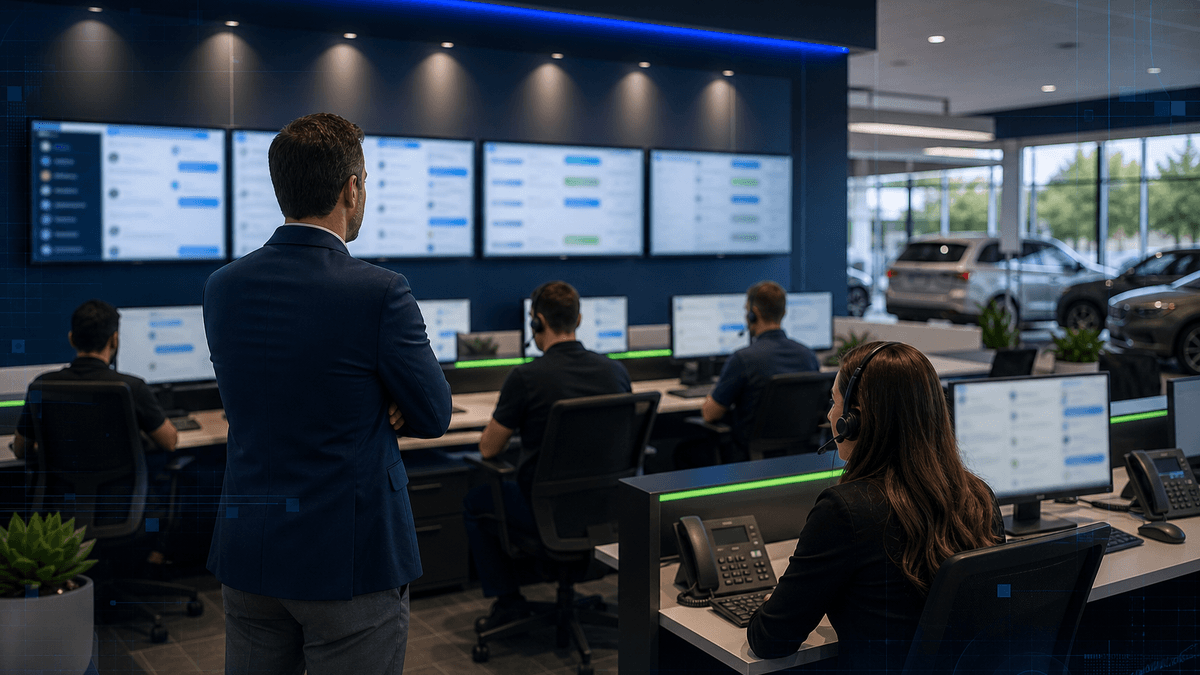
Does the AI continue nurture? Does a salesperson need to step in? Does the customer need an appointment reminder? Should a manager inspect an unresolved objection?
Should Response Bot watch for the customer’s next inbound reply? This is the part call tracking usually cannot own by itself: the movement from call evidence to accountable next action.
- A completed call should either close the loop or create a visible next action.
- Missed calls should trigger recovery, not sit as a report exception.
- Human handoffs should include the customer’s current state, not just a callback request.
- Managers should inspect unresolved conversations, not only call counts.
What managers should inspect in an automotive call tracking workflow
Sales managers do not need to throw away automotive call tracking. They need to manage it as one signal inside a larger conversation workflow. A stronger inspection routine looks at the call in sequence. Start with the source and prior customer context.
Then review what the call changed. Then inspect whether the next action happened. Finally, connect that activity to appointment, show, sold, or lost outcomes. This keeps managers from overreacting to surface-level call metrics.
A store with high call volume may still have weak follow-through. A store with fewer calls may be doing a better job moving customers through text, appointment scheduling, and timely human handoffs. The point is not to crown one channel. The point is to see whether the customer kept moving.
- Before-call state: source, prior messages, lead age, current intent, and open question.
- Call event: answered or missed, duration, recording, owner, and stated outcome.
- State change: appointment set, objection raised, customer qualified, inventory preference updated, or follow-up needed.
- After-call action: AI nurture, salesperson handoff, manager review, appointment reminder, or recovery sequence.
- Business result: appointment, show, sale, reactivation, or still-unresolved conversation.
Where TECOBI fits: calls belong inside an operating layer
TECOBI is not positioned as a replacement for every phone system or call tracking vendor. The more practical role is to keep call activity from becoming isolated from the customer conversation. In TECOBI, the operating layer around the customer matters: always-on conversations, persistent follow-up, inbound reply handling, proactive Auto Bot outreach, Response Bot routing, appointment support, human handoffs, and reports that help managers see engagement and outcomes. Calls belong inside that operating picture.
That distinction matters for sales managers evaluating automotive call tracking. If the tool only says “this call happened,” it may help marketing attribution but still leave the desk blind. If the workflow shows what the customer needed before the call and what happened after, the manager can coach, route, recover, and forecast with less guesswork. The goal is not more dashboards.
It is fewer unresolved customer conversations hiding behind completed activity.
- Use call tracking to understand phone activity and source performance.
- Use an AI CRM operating layer to preserve state before and after the call.
- Use Response Bot to keep inbound replies visible and ready for human handoff when needed.
- Use reporting to connect engagement, calls, sources, appointments, and outcomes instead of reviewing each channel separately.
The buyer takeaway: keep the call, fix the continuity
When you review an automotive call tracking vendor, do not stop at attribution and recordings. Ask workflow questions. Can managers see the customer’s prior conversation before judging the call? Can the call outcome update the next step?
Can missed calls start a recovery sequence? Can inbound replies after the call be handled without disappearing? Can reports connect call activity to appointments, shows, sold outcomes, and unresolved conversations? If the answer is no, the store may still need the call tracking tool.
But managers should be honest about what it is: a phone activity record, not a complete customer conversation workflow. That difference is where deals leak. Not always because nobody called. Often because the call happened, got counted, and then the conversation state went stale.
- Do not buy call tracking as a substitute for follow-up ownership.
- Do not judge call success only by answer rate or duration.
- Do not let recordings become the only place customer context lives.
- Do not separate call reporting from appointment, source, and outcome reporting.
- Do not assume a completed call means a completed customer step.